


Introduction
If your funnel runs on if → then rules, you’re routing—not reasoning. We built Productised.ai on AI reasoning: experiences that interpret context, weigh trade-offs, and return tailored guidance that actually reads like it was written for the user. That shift lifts conversions, slashes manual delivery, and raises trust. And yes—this is hard for rule-tree incumbents to pivot into without rebuilding foundations.
The pattern we kept seeing
Teams told us:
“We added a quiz to qualify leads, but results feel canned. People complete it, we get an email… then we still need a call to explain everything.”
We audited dozens. Under the hood: conditional logic.
If answer = “A”, show paragraph 17
If score > 70, show CTA 2
If industry = SaaS, branch B4…
Tidy. Predictable. Not human.
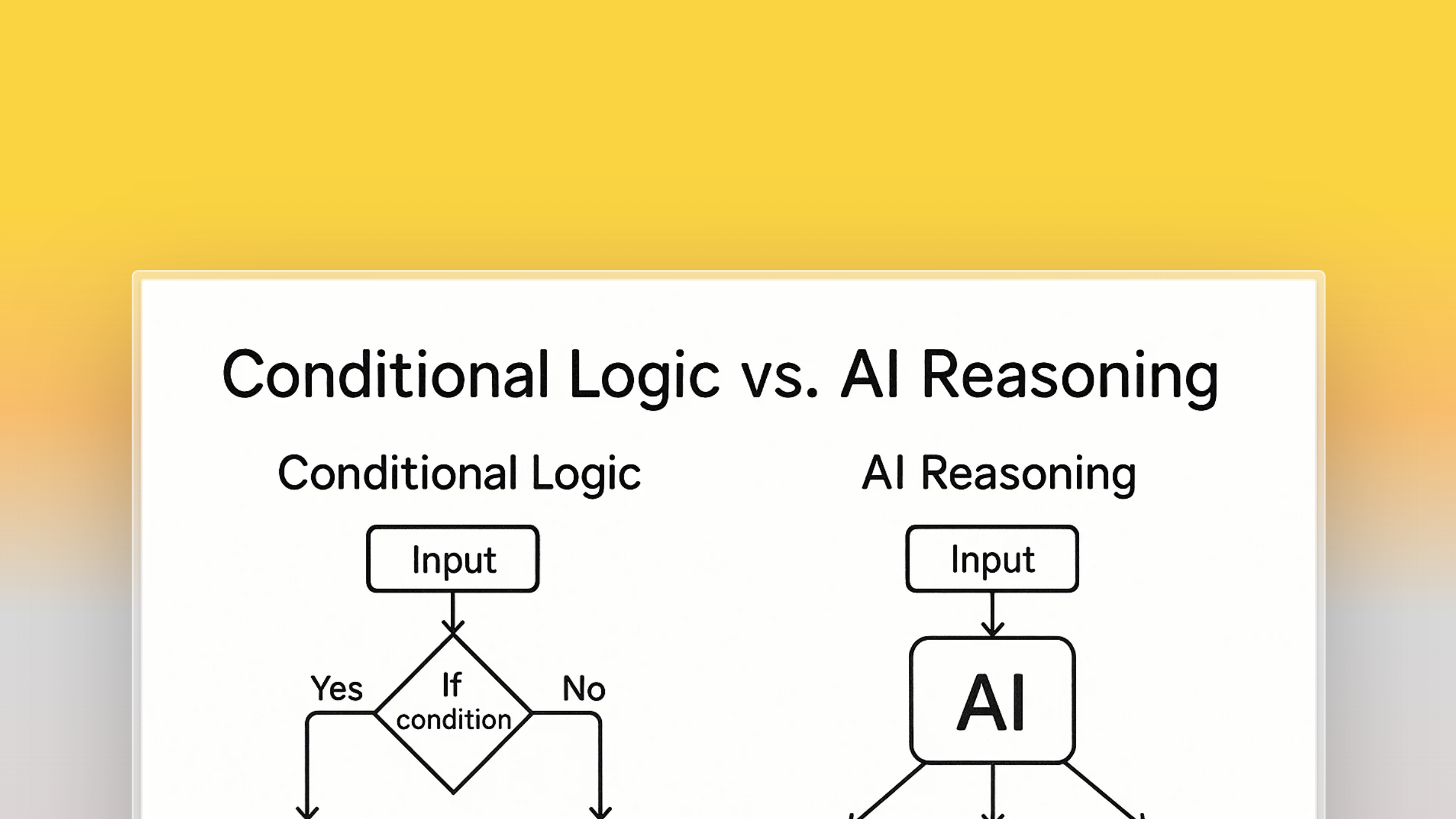
Conditional logic vs AI reasoning
Conditional logic
Fixed rules & branches
Binary, brittle outcomes
Good for routing/validation
“Personalisation” = swapping prewritten blocks
AI reasoning
Interprets all inputs together
Weighs relevance, nuance, contradictions
Produces explanations, not just selections
Personalisation = original, context-aware output
Think of logic as a flowchart; reasoning as a smart advisor.
Why incumbents will struggle to make this leap
Moving from trees to thinking is a platform shift:
- Data-model debt
Logic tools store static blocks attached to branches. Reasoning needs freeform synthesis + variable binding (and a different renderer).
- Authoring paradigm
Logic: map every path.
Reasoning: define goals, variables, constraints, tone; let the model write the connective tissue. New mental model for users and product.
- Output surface
Logic: “show section X.”
Reasoning: multi-page results with narrative + tiles + charts that change per user. More document engine than form renderer.
- Ops & monetisation
Rules are cheap; AI is metered. You need latency control, caching, evaluation, safety, cost management—and you must explain it.
- Org & GTM inertia
Libraries (scorecards, templates, onboarding) are branch-based. Re-platforming means new templates, success criteria—and new competition.
Bottom line: You can bolt GPT onto a form. You can’t bolt reasoning onto a branch.
What we built instead (and why)
Productised.ai = reasoning-first personalisation
Form → AI workflow → multi-page results
Forms capture signal. AI nodes diagnose → quantify → prescribe using your variables & tone. Results render as client-ready pages, not a single “score.”
Narrative + numbers
Uplift estimates + explanation + next step (what to do first, what to track). Pages support charts bound to variables (baseline vs potential, time saved, payback).
You remain the author
Bring prompts, data, or your OpenAI Agent. We standardise outputs to { result_text, variables } so anything can bind to tiles/charts/paragraphs—without hardcoding branches.
Built to scale
Multi-tenant, white-label, templateable—so agencies and experts ship under their own brand & domain.
Does reasoning actually convert better?
Early signals say yes: when users receive a credible explanation tailored to them, they move. We watch:
Completion → CTA click-through (not just “quiz complete”)
Uplift in qualified meetings (not raw volume)
Time reclaimed in pre-sales & onboarding
Margin increase attributable to self-service value
Reasoning proves value at first touch, not after a sales call.
“Can’t I just add GPT to my Typeform/ScoreApp?”
You can—and many do. Most end up with:
A GPT paragraph pasted into a static result block
No variable binding for charts/tiles
No multi-page narrative
No evaluation beyond “sounds right”
Better than nothing. Not AI productisation.
What this means for builders & brands
If you sell expertise (advisors, coaches, consultants, agencies), your moat is how you think. Put that thinking to work before the call.
If you’re still using branch-based quizzes to “personalise,” you’re capping trust and forcing manual explanation later.
Want to move faster? Swap conditional content for a reasoning workflow that:
Diagnoses the visitor’s context
Quantifies upside in their terms
Prescribes a next step with an evidence-backed rationale
That’s the shift from traditional forms and funnels to AI Products.
Where we’re taking it next
Template library by ICP (agencies, coaches, consultants, B2B sales) with domain-specific reasoning
Build with AI to have AI Products created for you, instantly replacing current quizzes, assessments and forms
Interactive widgets that showcase data in real time on results pages (graphs, tables), personalised to the end user