



Introduction
For many years the prevailing consensus in consulting circles has been that securing high-ticket sales is the ultimate objective to strive for. At first glance it’s hard not to see the advantages that arise from dealing exclusively with high-ticket, premium clients; from significantly higher revenue-per-sale to less operational hassles. However the reality is, high-ticket sales often add complexities to the picture that may stand to outweigh their potential benefits.
The reality is high-ticket sales, as lucrative as they can be, often make for unpredictability, lengthy lead nurturing processes and continued pressure to land the next deal. High customer acquisition costs and scalability constraints can also result very rapidly in reduced profitability for your business overall.
To be clear: the high-ticket model will always have its rightful place in the consulting world, however revenue diversification is fast becoming essential for sustainable growth and profitability.
3 Reasons Why High-Ticket Can Impair Sustainable Growth
Selling high-ticket services isn’t just about charging more—it’s about convincing people to make a significant financial commitment. And that’s where the real challenges begin.
1. Battling the complexity of the sales process.
A $10,000+ decision isn’t made overnight. High-ticket clients need multiple touchpoints, trust-building, and often weeks (if not months) of nurturing before they commit. This can make predictable cashflow and sustainable revenue more than a little challenging and often leads to the dreaded feast-or-famine cycle, especially when success rates can be as low as 10-20%.
2. Marketing to high ticket prospects is a costly exercise
Attracting premium clients often requires expensive ad campaigns, complex webinar funnels, or extensive networking—driving up costs before a sale even happens and the market for this deal size will always be a small one. According to ConsultingSuccess 70% of consultants have 8 or fewer sales calls per month and nearly 70% have a proposal win rate below 60% which demonstrates just how challenging it can be to convert premium clients.
3. The need for deep customisation.
High-ticket offers usually involve manual sales calls, one-on-one delivery, and deep customisation such as multiple meetings and tailored presentations which is not required for other approaches such as digital products, courses and memberships.
While high-ticket sales can be lucrative, an over-reliance on them creates a fragile business—one where a few bad months can throw everything off balance. The question isn’t whether you should sell high-ticket, but whether you should depend on it entirely.
3. Long-term Viability
Open source provides an "insurance policy" for users. Even if our company changed direction, the core technology would remain available to the community. This stability is crucial for organizations building mission-critical systems.
The Solution: Ascension and Increased Productisation
Instead of relying solely on high-ticket sales, the most successful consultants, coaches, and advisors in 2025 are adopting a multi-tiered growth model—one that blends productised offers with a strategic ascension ladder. This approach lowers customer acquisition costs, shortens sales cycles, and creates more predictable revenue.
Instead of expecting clients to commit to a high-value deal immediately, the ascension model meets them where they are and moves them progressively through higher-value services towards premium offerings.
Start with low-friction entry points at the top of the marketing funnel such as workshops, AI-powered digital products, or assessments.
Offer mid-tier solutions like group coaching, advisory retainers, or done-with-you programs.
Finally, position high-ticket services as the natural next step for the most qualified clients.
By using a tiered value ladder such as this you can minimize resistance, nurture trust and increase overall customer lifetime value, without being as exposed to the inherent risks associated with high-ticket deals.
How Productisation Creates Valuable Leverage in Your Business
The core advantage of the productised approach is unlocking the ability to transform onerous manual services into standardized and highly replicable offerings. Here’s a table that illustrates the possibilities:
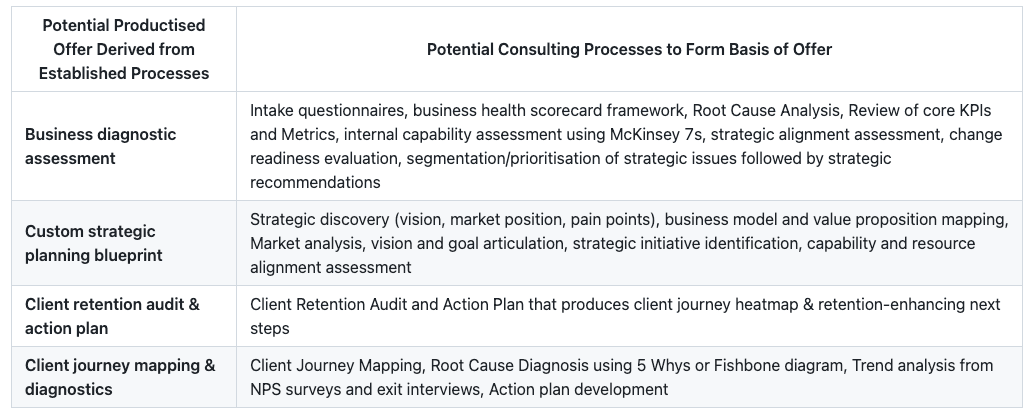
Productisation reduces time-to-revenue, makes sales more predictable, and allows you to serve more clients without more corresponding effort.
By combining ascension strategies with productised offers that cater to both acquisition and retention, you create the potential to unlock a sustainable pathway for your future growth that generates a continuous pipeline of engaged prospects and enthusiastic clients.
Core advantages of diversified offerings in a nutshell
- Lower customer acquisition costs without the friction of high-ticket commitment.
- Provide valuable consulting guidance to prospects with a limited budget or those who wish to receive value well in advance of the high-ticket engagement
- More predictable revenue with diversified income streams.
- Higher lifetime value (LTV) by keeping clients engaged long-term beyond courses or in-person consultations – continuous value delivery is possible from acquisition to retention.
- Greater scalability—serving more clients without increasing workload.
The future of consulting is about more than chasing the highest deal size—rather it’s about building a business that works for you, not the other way around.
The real question is:
Are you ready to break free from the high-ticket trap and embrace sustainable, scalable growth in future?